


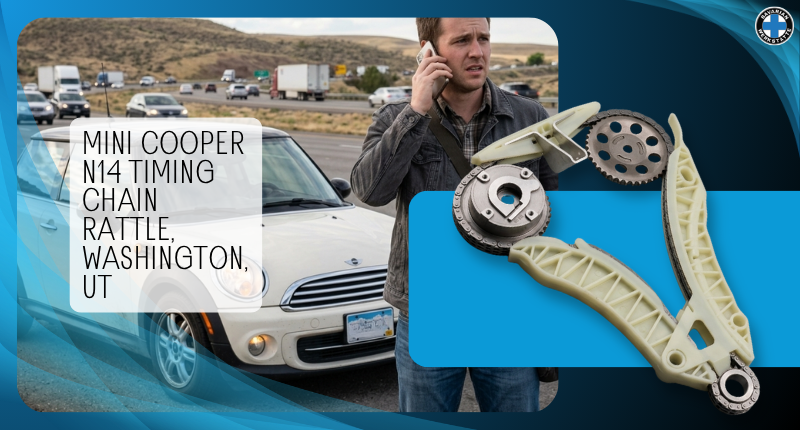
Cold morning in Washington. You turn the key on your MINI Cooper S and hear a metallic clatter from the front of the engine, maybe two seconds, maybe five, then it clears up and the car drives fine. That rattle is the N14 timing chain telling you the tensioner and guides are worn. It doesn’t fix itself.
Left alone, a stretched chain jumps a tooth and the valves meet the pistons. AAA has found that about one in three U.S. drivers can’t cover an unexpected repair bill without going into debt, and a wrecked 1.6-liter Prince engine is exactly the bill you don’t want. Fixing the rattle early costs a fraction of that.
Quick Summary: Key Takeaways
- Cold-start rattle: A one-to-five-second clatter at startup is the classic N14 chain tensioner symptom, usually between 60,000 and 100,000 miles.
- Codes to watch: P0016 and P0011 mean the crankshaft and camshaft timing no longer agree, so the chain has already stretched.
- Tensioner vs. full kit: A tensioner update runs $400 to $650 installed; chain, guides, and sprockets together land between $1,200 and $2,200.
- Oil is the multiplier: The N14 wears chains fast on thin, overdue oil, so 5,000-mile changes beat waiting for the service light.
- Ignoring it is the costly path: A jumped chain bends valves and turns a $1,500 repair into a $6,000 engine.
The rattle you hear at startup is a worn chain tensioner
That noise is the hydraulic chain tensioner bleeding down overnight. On the N14, the 1.6-liter turbo BMW built with PSA for the 2007 to 2010 Cooper S, oil pressure holds that tensioner against the chain. When the plunger wears, the chain slaps its plastic guides until pressure builds. Cold starts tell the truth. Two seconds of rattle is a warning, and ten seconds means the guides are already grooved with plastic shavings circulating through your oil pan.
MINI revised the tensioner part more than once, which says plenty about how common this is. Sludge accelerates everything. Cars arriving here with the loudest rattle almost always have a history of 12,000-mile oil changes and a lot of short trips.
Five symptoms separate a chain problem from a normal cold tick
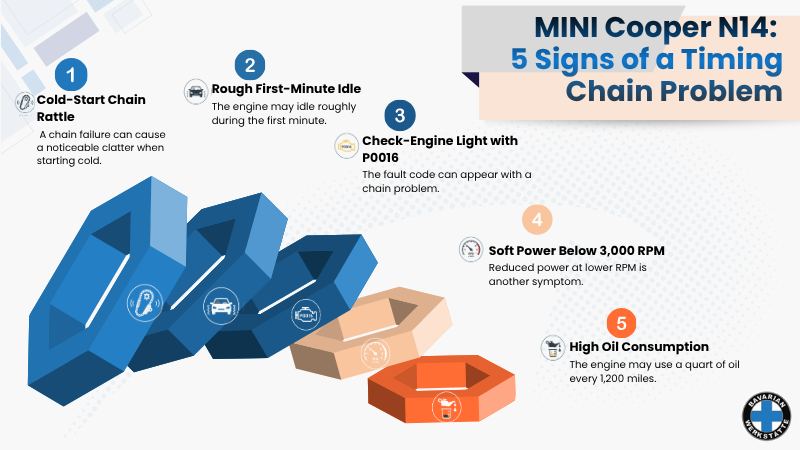
Start with the rattle, then check the rest. A chain failure on the N14 shows up as a cold-start clatter, a rough first-minute idle, and a check-engine light carrying P0016. Add soft power below 3,000 rpm and a quart of oil gone every 1,200 miles, and you have the full set. Count them.
One symptom alone can be something else. Four together is a chain and tensioner job. Carbon buildup on the intake valves, the other N14 signature since the engine is direct-injected, usually rides along and makes that cold idle even rougher.
Overdue oil and a weak tensioner design cause most N14 failures
Two things drive it. The tensioner plunger wears, and oil that sat 12,000 miles can’t hold pressure against it. The N14 chain guides are plastic, and Southern Utah heat, with 105-degree afternoons on I-15 between Washington and St. George, ages plastic faster than a coastal climate ever would.
Short trips make it worse. A four-mile run to Red Cliffs never gets the oil hot enough to boil off moisture and fuel, so the sump fills with the exact contaminants that varnish a tensioner shut.
Waiting turns a $1,500 chain job into an engine replacement
The chain either gets fixed or it jumps. When a stretched chain skips a tooth on the N14, the valves and pistons try to occupy the same space, and you’re shopping for a used engine instead of paying for a timing job. Do the math.
A tensioner update runs roughly $400 to $650 installed. A full kit with chain, tensioner, both guides, sprockets, and gaskets usually lands between $1,200 and $2,200, depending on what the timing cover reveals. A replacement N14 with labor starts near $6,000.
Our Washington shop confirms the chain before selling the job
Diagnosis comes first. That means a cold-start listen, a scan for correlation codes, a live look at camshaft timing deviation, and an oil pan inspection for plastic debris when the story isn’t clear. Guesswork is expensive.
On approval, the front of the engine comes apart on our lift at 1363 E Washington Dam Road, and the chain, updated tensioner, both guides, and the crank and cam sprockets all go in as a set. Reusing a worn sprocket with a new chain is how a rattle returns six months later. Owners from Washington, St. George, Hurricane, and Ivins bring MINIs here for exactly this repair.
Frequently Asked Questions
Q: Why does my MINI Cooper S rattle for a few seconds on cold start?
A: A worn hydraulic timing chain tensioner. Overnight it bleeds down, the chain goes slack, and it slaps the plastic guides until oil pressure builds. On a 2007 to 2010 Cooper S with the N14 engine, that noise is a chain job waiting to be scheduled.
Q: Can I keep driving a MINI with a timing chain rattle?
A: No farther than the shop. A slack chain can jump a tooth without warning, and on the N14 that bends valves. If the rattle lasts longer than three seconds or a P0016 code is stored, stop driving it and get the car on a lift.
Q: How often should I change the oil in a MINI Cooper S?
A: Every 5,000 miles with a full synthetic meeting BMW LL-01, regardless of what the service indicator says. MINI’s long intervals are the biggest reason these chains wear early. Short-trip drivers around Washington and St. George should hold that 5,000-mile mark.
Book an N14 chain inspection before the rattle gets longer
A two-second rattle today is a $2,000 decision. Wait six months and it becomes a $6,000 one. Bring your Cooper S in and we’ll listen to it cold, pull the codes, and tell you exactly what the timing cover holds.
Hours: Mon–Fri 9:00 AM – 5:00 PM; closed Saturday and Sunday
Website: bavarianwerkstatte.com