


Quick Takeaways:
- The ABS accumulator on older Jaguars stores brake fluid under pressure to power your brake assist. When it quits, the pedal turns hard and slow.
- Watch for a stiff pedal, an ABS or brake warning light, and an electric pump you can hear running long after the car is off.
- Long I-15 descents and the Virgin River Gorge grades lean hard on your brakes — a failed accumulator stretches stopping distance right where you need it most.
- The accumulator sphere holds up to 2,500 PSI. Swapping it safely takes proper depressurization and the right procedure.
- Bavarian Werkstatte on Washington Dam Road has the Jaguar-specific tools to replace the accumulator and test the whole brake-boost system.
Around Washington and St. George, brakes earn their keep on the downhill. Drop into the Virgin River Gorge on I-15, or come down the long grade off Cedar City with a boat in tow, and a soft, predictable pedal is the difference between a calm stop and a scary one. On older Jaguar XJ, S-Type, and XK models with the Bosch-based hydraulic brake-boost system, that predictable pedal comes from one part: the ABS accumulator. When it fails — and on these cars it does, usually with little warning — the pedal goes hard and stopping distances grow. Bavarian Werkstatte in Washington, UT handles these accumulator jobs with the procedure and safety steps the system demands.
The accumulator is what makes your Jaguar’s pedal feel light — and why it wears out
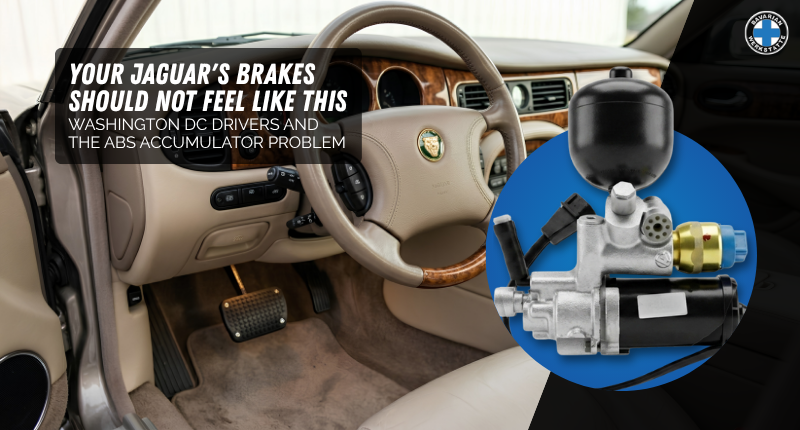
The accumulator is a pressurized sphere that stores brake fluid at 2,000 to 2,500 PSI, fed by an electric pump, and that stored pressure is what gives the pedal its easy, boosted feel. When it can’t hold pressure, the pump runs nonstop and the boost disappears.
Inside the sphere, a bladder keeps a nitrogen charge separated from the fluid. Age and heat do it in — the bladder ruptures or the nitrogen bleeds down, and the accumulator loses its charge. Desert summers don’t help; heat is hard on rubber and seals. This is a predictable age-and-use failure on these Jaguars, not a fluke. Learn what Jaguar brake service covers before it leaves you stranded.
What a failing accumulator feels like from the driver’s seat
The clearest sign is a brake pedal that suddenly fights back. One customer put it well — like stopping with bicycle brakes after years of power assist.
The car still stops. It just takes far more leg than you expect, and in a panic stop that extra effort costs you feet you don’t have. You may also hear the electric pump grinding away for long stretches while the car sits or crawls in traffic on St. George Boulevard — the pump working overtime to cover for a sphere that won’t hold charge. An ABS light or brake warning on the cluster usually rides along.
Why this is a job for a Jaguar specialist, not a quick brake shop
The sphere is stored energy — up to 2,500 PSI of it — so it has to be depressurized correctly before anyone touches a hydraulic fitting.
That means pumping the brake pedal a set number of times with the ignition off to bleed the stored pressure first. Skip it, and you risk a sudden high-pressure discharge — dangerous for the tech and anyone standing nearby. After the new sphere goes in, the system needs a proper bleed and a functional test to confirm pressure builds, holds, and releases through the ABS modulator. That test matters as much as the part. Schedule a Jaguar brake inspection and get it done right.
Putting it off turns one repair into two
Ignore the hard pedal and the failure cascades — the electric pump, running constantly to make up for a dead accumulator, cooks itself.
What starts as a straightforward accumulator swap becomes an accumulator-plus-pump job once the motor and relay burn out from the overwork. Catch it at the first sign of a stiff pedal and you replace one part, not two. Out here, where a summer tow to Sand Hollow or a loaded descent through the Gorge asks everything of your brakes, that’s not a repair to gamble on. Contact Bavarian Werkstatte about your Jaguar’s brakes and we’ll set a timeline that fits.
Insider Advice: A new accumulator takes a few days of normal driving to fully cycle and prove it’s holding charge. If the pump keeps running more than 10 to 15 seconds after you switch off in that first week, bring the car back for a pressure check. That’s not normal — it points to a bleed issue or a problem with how the new sphere seated.
Frequently Asked Questions
Q: Which Jaguar models have the ABS accumulator problem?
A: The Bosch-based hydraulic brake-boost and ABS system shows up on Jaguar XJ (X300, X308), XJ8, XJR, S-Type, and XK8/XKR models built from the mid-1990s into the early 2000s. Bring yours by Bavarian Werkstatte and we’ll confirm whether it uses this system.
Q: Is it safe to drive my Jaguar with a hard brake pedal?
A: If the pedal is only a little firm and you can still stop confidently at longer following distances, a short careful drive to the shop is usually fine. If the pedal is severely hard or your stopping distance has clearly grown, tow it — don’t chance it on I-15. Reach out and describe what you’re feeling.
Q: How much does Jaguar ABS accumulator replacement cost?
A: It depends on your model and whether the pump or other parts also need replacing. We’ll give you an estimate for your specific Jaguar after a diagnostic inspection — no guesswork over the phone.
Q: Does Bavarian Werkstatte work on other European cars besides Jaguar?
A: Yes. Alongside Jaguar, we service BMW, Mercedes, Audi, Volkswagen, Land Rover, and other European makes. Ask us about your vehicle.
Get Your Jaguar’s Brakes Checked Before the Next Long Grade
Visit Bavarian Werkstatte at 1363 E Washington Dam Road, Washington, UT 84780. If your Jaguar’s brake pedal has gone hard or the ABS light is on, schedule service online and have it looked at before the next descent down the Gorge. See bavarianwerkstatte.com for current hours.