


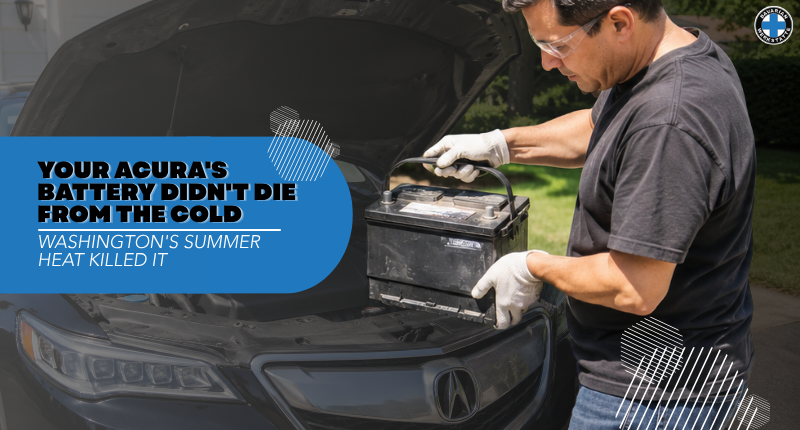
It’s 106 in Washington. You’re leaving Costco off Telegraph Street, the Acura cranks slow, then it just clicks. Dead battery. Most drivers blame winter for that, but out here in the St. George area it’s the opposite, and the desert summer is what actually cooks a battery to death on the one part that has to start your car every single time.
An Acura battery that was fine all spring can quit with almost no warning once the mercury climbs. Here’s the good news. A heat-killed battery is easy to catch before it strands you, and a quick test at our Washington Dam Road shop tells you whether yours has any summer left in it.
Quick Summary: Key Takeaways
- Heat, not cold, is the killer: Desert summer temperatures evaporate battery electrolyte and corrode the plates far faster than winter cold.
- Batteries die younger here: In hot climates, a car battery often lasts closer to three years than five.
- The clues are subtle: Slow cranking, dash flicker, or a battery light means test it now, before it leaves you stuck.
- Heat stresses the whole charging system: The alternator and voltage regulator also work harder when it’s 105 out.
- A test takes minutes: We load-test the battery and charging system so you’re not guessing in a parking lot.
Desert Heat Attacks a Battery From the Inside Out
Here’s what actually happens. A car battery makes power through a chemical reaction in liquid electrolyte, and heat speeds that chemistry up until it starts destroying the battery itself — underhood temperatures in a car parked in a Washington lot in July can top 140 degrees, and at that heat the electrolyte evaporates while the internal plates corrode and warp.
The damage is quiet. Your Acura keeps starting all summer while the battery loses capacity inside, until one hot morning there simply isn’t enough left to turn the engine over. Then it clicks. That’s no cold-weather problem. That’s June through September doing the work.
In Southern Utah, Batteries Simply Don’t Last as Long
Expect a shorter life than the sticker promises. AAA reports that batteries in hot southern regions last around 17 months less than in cooler northern climates, and the Washington and St. George heat sits firmly on the hot end of that scale, so a battery that might reach five years up in Oregon often gives out closer to three down here.
That changes the math. If your Acura’s battery is pushing three years, don’t wait for it to fail — get it tested before the next heat wave rolls in. Consumer Reports notes that for every 15 degrees above about 77°F, a battery’s life can be cut roughly in half, and a desert summer lives well past that line for months at a stretch.
The Warning Signs Your Acura Battery Is on Its Way Out
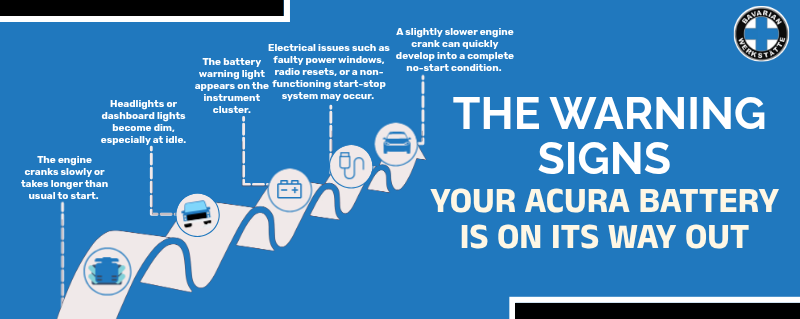
Your Acura drops hints first. Watch for slow, lazy cranking when you start it, headlights or dash lights that dim at idle, or a battery warning light glowing on the cluster, and don’t write off the electrical gremlins either — flaky power windows, a radio that resets, or a start-stop system that quits are all part of the same story.
Don’t ignore the little stuff. A battery that cranks a half-second slower this week can be a hard no-start next week. Seeing any of it in July? That’s the battery telling you plainly that it’s done.
Heat Wears on the Alternator and Charging System Too
The battery isn’t the only casualty. When it’s 105 outside, the alternator works overtime to keep everything charged while the A/C, the cooling fans, and the electronics all pull current at once, and a charging system that’s already marginal can start pushing too much or too little voltage — which cooks a battery even faster than the ambient heat alone.
So we don’t just swap the battery and wave you off. We test the alternator output and the voltage regulator, because a bad charging system will kill a brand-new battery in a matter of weeks. Fix the cause. Not just the symptom.
How We Test and Replace an Acura Battery in Washington
It starts with a real load test. We check the battery’s state of health under load, measure the alternator and charging voltage, and inspect the terminals and cables for the crusty corrosion that desert heat loves to encourage, which tells us whether you need a battery, a charging repair, or just a good cleaning and a tightened connection.
If you do need a battery, we fit the correct spec for your Acura and set it up so the car’s electronics behave. We’ve served Washington, St. George, Hurricane, and Santa Clara drivers since 2010. And we’ll give you a straight answer on how much summer your current battery has left in it.
Why Washington Drivers Trust Their Acuras to Bavarian Werkstatte
This is our bread and butter out here. We’re a family-owned European and import specialist on Washington Dam Road, and we see what a Southern Utah summer does to batteries and charging systems week in and week out, so we know exactly what to check before the heat leaves you stranded in a lot somewhere.
Straight talk. Correct parts. No upsell. Bring the Acura by for a battery and charging check before the next 100-degree stretch, and start the car with confidence all summer long.
Frequently Asked Questions
Q: Why do car batteries die in summer instead of winter?
A: Heat is the leading cause of battery failure, not cold. High temperatures evaporate the battery’s electrolyte and corrode its internal plates, permanently cutting capacity, and the damage builds quietly through summer until the battery can no longer start the car — so many batteries that seemed fine all season fail on a hot day rather than a cold one.
Q: How long does a car battery last in Southern Utah’s heat?
A: Less than the label suggests. AAA data shows batteries in hot regions last roughly 17 months less than in cooler climates, so in the Washington and St. George heat a typical battery often lasts closer to three years than five, which means one around three years old is worth testing before summer.
Q: What are the signs my Acura battery is failing?
A: Look for slow or lazy cranking, headlights and dash lights that dim at idle, a battery warning light, or electrical quirks like the windows and radio acting up, and take them seriously — in hot weather those symptoms can jump from mild to a no-start quickly, so a load test is worth doing as soon as you notice them.
Q: Can heat damage more than just my battery?
A: Yes. Desert heat also stresses the alternator and voltage regulator, which have to work harder when the A/C and cooling fans run, and a failing charging system can overcharge or undercharge and destroy even a brand-new battery — which is exactly why we test the whole charging system rather than only replacing the battery.
Get Your Acura’s Battery Tested Before the Next Washington Heat Wave
Cranking slow in the heat? Don’t wait for the click in a parking lot — bring the Acura in for a quick battery and charging check.
Bavarian Werkstatte — 1363 E Washington Dam Road, Washington, UT 84780
Hours: Mon–Fri 9:00 AM – 5:00 PM; Sat–Sun closed
Website: bavarianwerkstatte.com